
Level 3 Autism Symptoms: Communication Challenges, Behaviors, and Support Needs

Updated: Oct 21
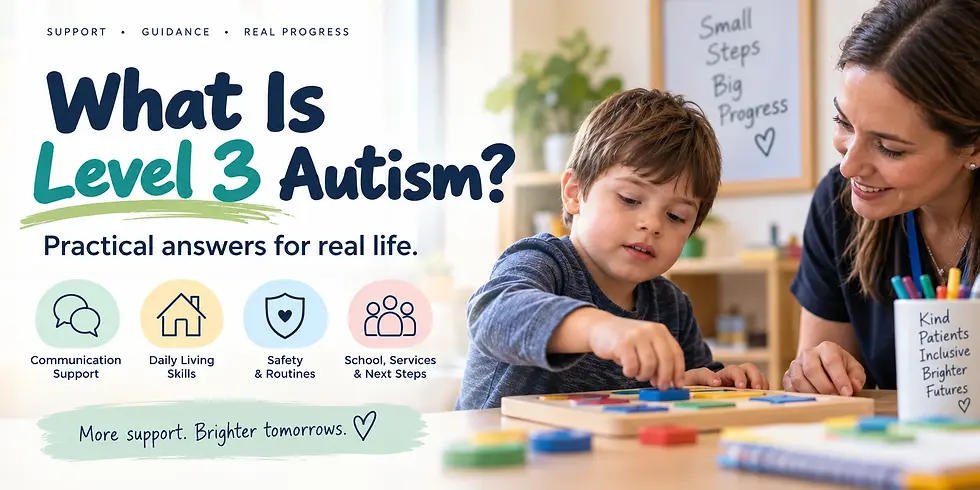
Level 3 autism is a classification of Autism Spectrum Disorder (ASD) that means a person requires very substantial support with communication, social interaction, and everyday activities. Children with Level 3 autism may use few spoken words, communicate through gestures or assistive devices, and need significant help managing routines and transitions.
These support needs can affect nearly every part of daily life, from expressing basic needs to getting dressed or participating in school activities. However, every child has different strengths and abilities. Understanding Level 3 autism symptoms can help parents recognize their child's needs and identify appropriate support.
What Is Level 3 Autism Spectrum Disorder?
Level 3 autism is the highest support classification in the Diagnostic and Statistical Manual of Mental Disorders (DSM-5). It describes individuals who require very substantial support because of significant differences in social communication and restricted or repetitive behaviors.
The DSM-5 identifies three autism levels:
Level 1 Autism: Requires support.
Level 2 Autism: Requires substantial support.
Level 3 Autism: Requires very substantial support.
Although these classifications are sometimes described as different types of autism, they are support levels within the same autism spectrum diagnosis, not separate conditions.
A child with autism level 3 may need extensive assistance with communication, self-care, transitions, and other everyday activities.
However, the diagnosis does not determine a child's intelligence, personality, or future potential. Support needs can change over time, and clinicians may assign different levels for social communication and repetitive behaviors.
Parents can explore our guide to autism levels and what Level 1, Level 2, and Level 3 mean for a broader understanding of these classifications.
What Are the Common Signs and Symptoms of Level 3 Autism?
The most common Level 3 autism symptoms involve significant communication challenges, limited social interaction, difficulty adapting to change, and repetitive behaviors that interfere with everyday activities.
Some children also experience considerable sensory sensitivities and require substantial help with daily living skills.
1. Significant Verbal and Nonverbal Communication Challenges
Children with Level 3 autism often experience substantial difficulties communicating their thoughts, feelings, and everyday needs.
Some children use only a few spoken words, while others do not communicate through speech.
For example, a child may take a parent's hand and lead them toward the refrigerator instead of verbally requesting a drink.
Other communication differences may include:
Using few spoken words or short phrases.
Difficulty initiating or responding to conversations.
Communicating through gestures, pictures, or assistive technology.
Repeating words or sounds.
Difficulty expressing pain, discomfort, or emotions.
A child who does not speak may still understand language and communicate meaningfully through other methods.
Limited speech does not necessarily indicate limited understanding or intelligence.
Supporting functional communication is often an important priority for children with Level 3 autism.
2. Difficulty Initiating and Responding to Social Interactions
Children with autism level 3 may have significant difficulty initiating or responding to social interactions.
A child might not respond consistently when someone calls their name or attempts to begin a conversation. Others may respond primarily to familiar people or when communication relates to an immediate need.
Parents may notice:
Limited initiation of social interactions.
Difficulty responding to unfamiliar people.
Reduced use of conventional gestures or facial expressions.
Challenges participating in group activities.
Preference for familiar interactions and environments.
These differences should not be interpreted as a lack of emotions or an inability to form relationships.
Children with Level 3 autism can develop meaningful connections with family members, caregivers, and others, even when they communicate differently.
3. Extreme Difficulty With Changes in Routine
Predictable routines can be particularly important for children with Level 3 autism.
Unexpected changes may cause considerable distress because the child may have difficulty understanding what is happening, preparing for a transition, or communicating discomfort.
For example, taking a different route home from school or changing the order of a morning routine may create significant frustration.
Other challenging situations can include:
Moving between activities without preparation.
Visiting unfamiliar environments.
Changes in meal or bedtime routines.
Unexpected interruptions during preferred activities.
Introducing unfamiliar foods or clothing.
Some children may cry, withdraw, become overwhelmed, or experience meltdowns when changes occur.
Visual schedules, advance preparation, and consistent communication can help children understand transitions and feel more secure.
4. Frequent Repetitive Behaviors and Restricted Interests
Repetitive behaviors are a common characteristic across autism levels. For children with Level 3 autism, these behaviors may occur frequently or significantly affect participation in daily activities.
Examples include:
Rocking, pacing, or hand-flapping.
Repeatedly spinning or arranging objects.
Watching the same video or activity.
Repeating particular sounds or movements.
Becoming intensely focused on specific objects or interests.
These movements are often described as stimming.
Stimming can help children regulate emotions, process sensory information, or express excitement.
Not every repetitive behavior requires intervention. Harmless movements can serve an important purpose, and support should focus on safety and well-being rather than stopping behaviors simply because they look unusual.
5. Sensory Sensitivities and Sensory Overload
Some children with Level 3 autism experience significant differences in how they respond to sensory information.
Sounds, lighting, clothing textures, smells, or physical contact may feel uncomfortable or overwhelming.
For example, a child may cover their ears when a blender starts or become distressed by the noise and lighting in a crowded supermarket.
Others actively seek sensory experiences, such as movement, pressure, or repetitive visual stimulation.
Sensory challenges may affect:
Eating and food preferences.
Clothing and personal hygiene.
Participation in school activities.
Sleep and daily routines.
Comfort in unfamiliar environments.
Understanding sensory preferences and adjusting the environment can help children participate more comfortably in everyday activities.
6. Self-Injurious Behaviors and Safety Concerns
Some children with Level 3 autism engage in behaviors that may put their safety at risk.
Examples can include head-banging, biting themselves, or scratching their skin.
These behaviors are not universal features of Level 3 autism.
When they occur, possible contributing factors include pain, medical conditions, sensory distress, difficulty communicating, or overwhelming situations.
For example, a child who cannot easily communicate that something hurts may become increasingly distressed.
Families should work with qualified healthcare professionals to identify the possible causes of self-injurious behavior and develop appropriate safety and treatment plans.
The priority is understanding what the child is experiencing and supporting safer ways to communicate or cope.
7. Significant Support Needs With Daily Living Activities
Children with Level 3 autism may require extensive assistance with activities such as dressing, eating, toileting, bathing, and other personal care routines.
For example, a child may need physical assistance or step-by-step guidance to wash their hands or get dressed.
Some children also require close supervision because of difficulties recognizing danger, communicating emergencies, or navigating unfamiliar environments.
Daily living support may focus on:
Developing personal hygiene routines.
Practicing dressing and feeding skills.
Learning to request assistance.
Building safety awareness.
Participating in household activities.
These skills can be introduced gradually using individualized teaching strategies that reflect the child's abilities and comfort.
How Do Autism Levels 1, 2, and 3 Compare?
The three autism levels describe differences in the amount of support a person needs with social communication and restricted or repetitive behaviors.
While all three levels share core autism characteristics, the intensity of support typically increases from Level 1 to Level 3.
Characteristic | Level 1 Autism | Level 2 Autism | Level 3 Autism |
Support required | Requires support | Requires substantial support | Requires very substantial support |
Communication | May speak fluently but struggle with social exchanges | May have more significant verbal and nonverbal communication difficulties | Often has severe communication challenges and may use few or no spoken words |
Social interaction | May find complex social situations difficult | Often needs considerable support initiating interactions | May initiate very few interactions and respond mainly to direct approaches |
Changes in routine | Changes may cause difficulty or distress | Changes can significantly disrupt daily activities | Changes may cause extreme distress and substantial disruption |
Repetitive behaviors | May interfere with certain activities | May interfere across multiple settings | May significantly interfere with functioning across settings |
Daily functioning | May manage many activities independently | Often needs regular assistance | May require extensive assistance and supervision |
These descriptions are general patterns rather than fixed rules.
A child diagnosed with Level 3 autism may have abilities that are not reflected in the table. Similarly, children with lower support classifications can experience significant difficulties in particular situations.
For more detailed comparisons, read our guides to Level 1 autism, Level 2 autism, and Level 3 autism support and New Jersey resources.
What Therapies Help Children With Level 3 Autism?
Children with Level 3 autism often benefit from individualized support involving multiple healthcare and educational professionals.
Treatment may include speech-language therapy, occupational therapy, behavioral intervention, and specialized educational services.
The right combination depends on the child's communication abilities, safety needs, daily living skills, and family priorities.
Speech Therapy and Augmentative Communication (AAC)
Speech-language therapy can help children develop reliable ways to communicate their needs, preferences, and emotions.
For children who use few or no spoken words, therapists may recommend augmentative and alternative communication (AAC).
AAC options can include:
Picture communication boards.
Speech-generating tablets or devices.
Sign language or gestures.
Picture Exchange Communication System (PECS).
Other individualized communication systems.
For example, a child may learn to select a picture or use a speech-generating device to request water, ask for a break, or express discomfort.
AAC does not prevent children from developing speech. It can provide an additional communication method and may support language development.
Occupational Therapy for Sensory and Daily Living Needs
Occupational therapy helps children participate in meaningful everyday activities.
For children with Level 3 autism, treatment may focus on dressing, feeding, personal hygiene, fine motor skills, and sensory needs.
An occupational therapist may also recommend environmental adjustments to make daily routines more manageable.
For example, changes to clothing materials, mealtime environments, or bathroom routines may help reduce sensory discomfort.
ABA Therapy for Level 3 Autism
Applied Behavior Analysis (ABA) therapy can help children with Level 3 autism develop communication, self-care, and functional daily living skills.
A Board Certified Behavior Analyst (BCBA) evaluates the child's strengths, challenges, and family priorities before developing an individualized treatment plan.
Depending on the child's needs, ABA therapy may address:
Functional communication: Requesting food, assistance, breaks, or preferred activities.
Daily living skills: Participating in dressing, toileting, feeding, and hygiene routines.
Behavioral flexibility: Preparing for transitions and adapting to changes.
Safety skills: Learning safer responses in situations involving wandering or other risks.
Emotional regulation: Developing appropriate ways to communicate discomfort or request support.
When self-injurious or dangerous behaviors occur, treatment should begin with understanding their possible causes and addressing medical or environmental factors.
ABA therapy should prioritize the child's safety, comfort, autonomy, and quality of life rather than suppressing harmless autistic behaviors.
In-Home ABA Therapy for Level 3 Autism
Children with substantial support needs may benefit from learning practical skills in familiar surroundings.
Through in-home ABA therapy in New Jersey, Seed & Grow ABA helps children practice communication, daily routines, and independence skills in their home environment.
For example, a therapist may help a child learn to request assistance during mealtimes, participate in dressing routines, or use a communication device during everyday activities.
Parents and caregivers can also learn strategies for supporting these skills between therapy sessions.
Virtual ABA Therapy and Caregiver Coaching
Virtual therapy may provide additional support for some families, particularly through parent coaching and caregiver guidance.
Seed & Grow ABA offers virtual ABA therapy for families seeking appropriate remote treatment options.
However, children with Level 3 autism may require direct, hands-on assistance that cannot be provided through virtual sessions alone.
A clinical assessment can help determine whether caregiver coaching, in-home services, or a combination of treatment approaches is appropriate.
What Long-Term Support Do Children With Level 3 Autism Need?
Some children with Level 3 autism require ongoing assistance as they grow. Support needs may change throughout childhood, adolescence, and adulthood.
Planning can involve healthcare services, education, family resources, and community-based programs.
Individualized Education Programs (IEPs)
Children who qualify for special education services may receive an Individualized Education Program (IEP).
An IEP identifies educational goals, accommodations, and services based on the child's evaluated needs.
Depending on the assessment, supports may include communication services, specialized instruction, assistive technology, or individualized assistance.
Family and Caregiver Support
Caring for a child with substantial support needs can involve complex daily responsibilities.
Parent coaching, respite services, and coordination between healthcare professionals can help families manage treatment and daily routines.
Families may also benefit from connecting with local autism support organizations.
Planning for Adulthood
As children approach adulthood, families may need to explore vocational services, adult disability programs, supported living options, or other community resources.
In New Jersey, eligibility for state-funded services and Medicaid programs depends on factors such as age, disability-related needs, and program requirements.
Beginning transition planning early can help families understand available options before their child's educational services change.
Frequently Asked Questions About Level 3 Autism
Is Level 3 autism the most severe type of autism?
Level 3 is the highest support classification in the DSM-5 and indicates that a person requires very substantial support. However, autism levels are not separate types of autism, and Level 3 does not determine a person's intelligence, personality, or potential for development.
Can children with Level 3 autism learn to communicate?
Yes. Children with Level 3 autism can develop communication skills through individualized support. Some may develop or expand spoken language, while others communicate through gestures, pictures, sign language, or AAC devices. The goal is reliable, meaningful communication.
Can a child with Level 3 autism attend school?
Yes. Children with Level 3 autism can receive public education and may qualify for specialized services through an IEP. School placement and support are determined through individualized evaluations rather than the diagnostic level alone.
Can Level 3 autism improve with therapy?
Children with Level 3 autism can learn new skills and make meaningful progress with appropriate support. Improvements may involve communication, personal care, safety, and participation in daily activities. Autism is not something therapy is intended to cure, and progress varies for each child.
Do all children with Level 3 autism have self-injurious behaviors?
No. Self-injurious behaviors are not present in every child with Level 3 autism. When they occur, families should seek professional evaluation to identify possible medical, communication, sensory, or environmental causes and develop appropriate safety strategies.
How much ABA therapy does a child with Level 3 autism need?
There is no fixed number of ABA therapy hours for every child with Level 3 autism. A BCBA should recommend treatment intensity based on individual assessments, communication abilities, safety concerns, functional skills, and family priorities. The diagnostic level alone should not determine therapy hours.
Helping Your Child With Level 3 Autism
Level 3 autism involves very substantial support needs, but each child has their own strengths, preferences, and ways of communicating.
Some children need extensive help with communication, while others require additional support with daily routines, sensory experiences, or safety. Understanding these individual needs can help families make informed decisions about therapy and long-term care.
At Seed & Grow ABA, we help New Jersey families explore individualized ABA therapy focused on functional communication, independence, and meaningful everyday skills.
Looking for Level 3 autism therapy support in New Jersey? Contact Seed & Grow ABA to discuss your child's needs, available treatment options, and insurance coverage.


