
What Are Adaptive Behavior Skills in ABA Therapy?


If your child is receiving ABA therapy or about to start, you have probably heard the term adaptive behavior. It comes up in evaluations, treatment plans, and progress reports. But most of the time nobody stops to explain what it actually means for your child's daily life.
Adaptive behavior is the collection of practical skills a person uses to function in everyday situations. For children, that includes things like getting dressed, asking for what they need, following a routine, using the bathroom, eating a meal, and handling a change in plans without falling apart.
These are not academic skills. They are the skills that determine how much of daily life a child can manage on their own.
For many children with autism, adaptive skills do not develop at the same pace as other abilities. A child might have a strong vocabulary but not be able to tell someone they need help. They might solve puzzles well beyond their age level but need an adult to walk them through every step of getting ready in the morning. That gap between what a child knows and what a child can do independently is exactly what adaptive behavior goals in ABA are designed to close.
Why Adaptive Skills Are Different From Intelligence
This is one of the most confusing parts of autism for families. A child can be clearly intelligent and still struggle with basic daily tasks. Parents sometimes hear that their child tested well cognitively but scored much lower on adaptive behavior, and they do not understand how both things can be true at the same time.
Cognitive ability measures what a child can learn, understand, and figure out. Adaptive behavior measures what a child actually does on their own in real situations.
A child might understand the steps involved in brushing their teeth. They can explain them if asked. But when it is time to brush, they stand at the sink and wait for someone to tell them what to do next. The knowledge is there. The independent execution is not.
This gap shows up constantly in autism. It appears in morning routines, at mealtimes, during transitions, in social situations, and at school. It is also the reason that IQ scores alone do not predict how much support a child will need day to day.
Adaptive behavior assessments exist specifically to measure this. They look at what the child does across real environments, not what the child can do under ideal conditions with prompting and support. That distinction matters because ABA treatment goals are built around closing the gap between ability and independent performance.
Which Adaptive Skills ABA Typically Works On
The specific skills depend entirely on the child. A three-year-old who is not yet communicating basic needs will have a different set of adaptive goals than a seven-year-old who can talk but cannot get through a morning routine without step-by-step help.
That said, adaptive behavior goals in ABA usually fall into a few broad areas of daily life.
Self-care and daily routines. This includes skills like brushing teeth, washing hands, getting dressed, using the bathroom, feeding themselves, and managing basic hygiene. For younger children, the starting point might be tolerating the steps of a routine. For older children, it might be completing the full routine independently without reminders.
Communication for everyday needs. Adaptive communication is not about vocabulary size. It is about whether a child can use language or another communication system to get through their day. Can they ask for help? Can they tell someone they are done, or that something hurts, or that they need a break? Can they answer a simple question from an unfamiliar person? These functional communication skills often overlap with other ABA goals, but they are a core part of adaptive behavior.
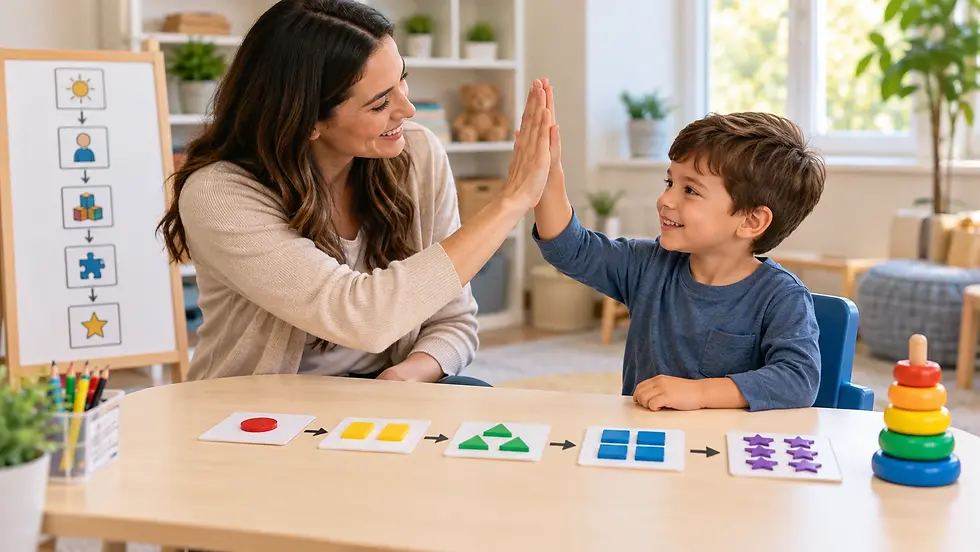
Responding to changes and transitions. Many children with autism struggle when routines shift or activities end unexpectedly. Adaptive goals in this area might involve following a visual schedule, moving from one activity to another without significant distress, or handling a cancelled plan without a prolonged meltdown.
Safety awareness. This includes responding to their name, stopping when told to stop, staying with a caregiver in public, and understanding basic safety rules. For some families, safety goals are the most urgent adaptive skills on the treatment plan.
Social participation. Greeting someone, taking turns, sharing space with other children, participating in a group activity, or playing alongside a peer. These are not purely social skills in the way most people think of them. They are adaptive because they determine whether a child can function in a classroom, a playdate, or a family gathering.
Household and community tasks. As children get older, adaptive goals may expand to include things like cleaning up after an activity, helping with simple chores, following multi-step directions, making simple choices, or navigating familiar community settings with less adult support.
How Adaptive Skills Are Actually Taught in ABA
This is where the competitor content usually stops. Most articles list the skills and explain why they matter, then move straight to a call to action. The part parents actually want to understand, the part where their child is learning, gets skipped.
ABA teaches adaptive skills through a structured process that looks different depending on the skill, the child, and the setting. But the general approach follows a consistent pattern.
Task analysis. The BCBA breaks the skill into smaller steps. Hand washing, for example, is not taught as one action. It is broken into a sequence: walk to the sink, turn on the water, wet both hands, get soap, rub hands together, rinse, turn off the water, dry hands. Each step is taught individually until the child can chain them together.
The number of steps depends on the child. A child who already tolerates water and can follow one-step directions might have a shorter task analysis. A child who resists water or has difficulty with motor planning might need each step broken down further.
Prompting. When the child is first learning, the therapist provides support to help them complete each step. This might be a physical prompt (guiding the child's hands), a model (showing them what to do), a gestural prompt (pointing), or a verbal prompt (telling them the next step).
The level of prompting depends on what the child needs. Some children learn quickly from a demonstration. Others need hand-over-hand guidance at first and then gradually less physical support over time.
Fading. This is the part that separates ABA from simply helping a child do a task. The therapist systematically reduces the amount of support until the child can complete the skill independently. If a child started with full physical prompts for hand washing, the therapist might move to partial physical prompts, then gestures, then just a verbal reminder, and eventually the child walks to the sink and washes their hands without any prompting at all.
Fading matters because a child who can only complete a task when someone is standing next to them prompting every step has not truly learned the skill. The goal is independence.
Reinforcement. When the child completes a step or the full task, the therapist provides reinforcement. For young children, this might be a preferred item, a favorite activity, or enthusiastic praise. The type of reinforcement is matched to what actually motivates that particular child.
Over time, the reinforcement is also adjusted. A child who initially needed a tangible reward after every step might eventually respond to verbal praise at the end of the routine. The goal is for the natural result of the skill to become reinforcing on its own.
Generalization. A child who can wash their hands at the therapy table but not in the school bathroom has not fully learned the skill. ABA programs work on practicing adaptive skills across different environments, with different people, and using different materials so the skill transfers to real life. This is one of the reasons parent involvement matters so much. The more settings where the skill is practiced, the more likely it is to stick.
How the BCBA Decides Which Adaptive Skills to Work on First
A child might have gaps in self-care, communication, safety, transitions, and social participation all at the same time. The BCBA cannot work on everything at once, so prioritization is a normal part of treatment planning.
Several factors typically influence which adaptive skills are targeted first.
Safety. If a child runs away from caregivers, does not respond to their name, or cannot communicate pain or danger, those skills usually come first regardless of what else is going on.
Daily impact on the family. If a family's biggest source of stress is that their child cannot get through a morning routine, or that every meal ends in a meltdown, or that toileting is creating problems at school, those functional concerns often drive early goal selection. The BCBA should be asking what daily situations are hardest for the family, not just what the standardized assessment flagged.
Prerequisite skills. Some adaptive skills depend on others. A child who cannot follow a simple direction or imitate a model may need those foundational skills before more complex routines can be taught. The BCBA considers what the child needs to learn before a bigger goal becomes realistic.
What the child is developmentally ready for. A child who is not yet consistently using any communication system is probably not ready for a goal around conversational turn-taking. The BCBA matches goals to where the child is, not where the parent hopes they will be in six months.
Caregiver input. This is not a formality. Parents know which skills matter most in their child's daily life. A clinician who writes goals without asking what the family actually needs is missing information that changes the treatment plan.
The result is a set of goals that are specific, measurable, and tied to real situations the child faces every day. A good adaptive behavior goal does not say "improve self-care." It says something like "the child will independently complete a four-step hand-washing routine in three out of four opportunities across two settings."
What Progress Looks Like and How It Is Measured
Adaptive skill progress is measured through data, not impressions.
During therapy sessions, the therapist records whether the child completed each step of a task independently, with a prompt, or not at all. Over time, that data shows whether the child is completing more steps on their own and needing less support.
For parents, progress in adaptive skills can sometimes be hard to see in the moment because it happens gradually. A child who needed full physical prompts for every step of getting dressed three months ago might now only need a verbal reminder for two steps. That is real progress, even though the child is not yet fully independent.
There are also standardized tools that measure adaptive behavior more broadly. The Vineland Adaptive Behavior Scales is one of the most commonly used. It is typically completed through an interview with the parent or caregiver and covers communication, daily living skills, socialization, and motor skills. The Vineland produces scores that can be compared to same-age peers and tracked over time to show whether the gap is narrowing.
The Assessment of Functional Living Skills, or AFLS, takes a more task-specific approach. It breaks down practical skills into detailed checklists that the clinician and caregiver complete together. This can be useful for identifying exactly where a child gets stuck within a routine and for tracking progress at a granular level.
Both tools serve a purpose. The Vineland gives the broader picture. The AFLS gives the finer detail. The BCBA may use one or both depending on the child's needs and what the treatment plan requires.
Parents should expect to receive updates that are specific enough to be useful. "Your child is making progress" is not a progress update. "Your child now completes three out of five hand-washing steps independently, up from one step last month" tells the family something real.
What Parents Can Do at Home
Adaptive skills do not stick if they are only practiced during therapy sessions. The child needs to use them in real life, which means parents play a direct role in whether those skills transfer.
That does not mean parents need to become therapists. It means being intentional about a few things.
Use the same steps the therapist uses. If the therapy team has a task analysis for brushing teeth, ask for a copy and follow those same steps at home. Consistency between therapy and home makes it easier for the child to learn the routine instead of learning two different versions of it.
Resist the urge to do it for them. This is hard, especially when mornings are rushed and it is faster to just put their shoes on yourself. But every time you complete a step the child can do independently, you are unintentionally reinforcing their dependence on that prompt. When possible, give them time to try before stepping in.
Wait before prompting. If the child pauses during a routine, give them a few seconds before jumping in with a reminder. That pause is where independence develops. Many children can complete the next step if they are given the time to process it.
Ask the BCBA which skills to practice. Not every adaptive goal is ready for home therapy practice at the same time. The BCBA can tell you which skills the child is close to mastering and which ones would benefit most from practice outside of sessions.
Keep expectations realistic. A child who just started working on a new routine at the clinic is not going to perform that routine perfectly at home. Progress at home typically follows progress in therapy, not the other way around. If a skill is not transferring, tell the treatment team so they can adjust.
Parent involvement is not optional for adaptive skill development. The research on ABA outcomes consistently shows that children make more progress when skills are reinforced across environments, and home is the most important environment a child has.
When Adaptive Skills Become the Main Focus of Treatment
Not every ABA treatment plan centers on adaptive behavior from the start. Some children begin therapy with an urgent need to address challenging behavior, communication, or safety. But for many children, adaptive skills eventually become the most important part of the treatment plan.
This often happens when a child has made progress with communication and behavior but still depends on adult support for daily tasks that other children their age can manage on their own.
It also happens as children get older. A four-year-old who needs help getting dressed is developmentally typical in many cases. A nine-year-old who needs the same level of help is falling further behind their peers, and the gap becomes more noticeable with time.
For some families, adaptive behavior is the top priority from the beginning because the daily routines are what create the most difficulty. Toileting, mealtime, getting ready for school, bedtime, and handling transitions might be consuming the entire family's energy. In those situations, the BCBA may focus heavily on adaptive goals from the first treatment plan.
Adaptive skills also interact directly with challenging behavior. A child who cannot communicate that they are overwhelmed may have a meltdown instead. A child who cannot follow a routine independently may resist when an adult tries to move them through it. Teaching the adaptive skill does not just build independence. It can also reduce the situations that trigger problem behavior in the first place.
That connection is worth understanding. Adaptive behavior and challenging behavior are not separate topics. They are often two sides of the same problem.
What This Means for Your Family
Adaptive behavior is not a clinical abstraction. It is the difference between a child who can get through a morning and a child who cannot. It is the difference between a family that can go to a restaurant and one that avoids leaving the house.
When ABA therapy targets adaptive skills effectively, the results show up where they matter most. Not on a data sheet, but in the moments where your child does something for the first time without being told. The first time they walk to the sink and wash their hands on their own. The first time they ask for help instead of screaming. The first time a routine goes smoothly.
If your child is in ABA or about to start, ask the treatment team which adaptive skills are being targeted, how they are being taught, and what you can do at home to help. Those are the questions that keep the therapy focused on what actually changes your child's life.


Comments