
What does a BCBA do, and what does an RBT do?

You've seen both letters on paperwork, maybe on a business card, maybe in a text from your service coordinator, and it's not obvious which one is showing up to your house on Tuesday. It matters, because they do different jobs.
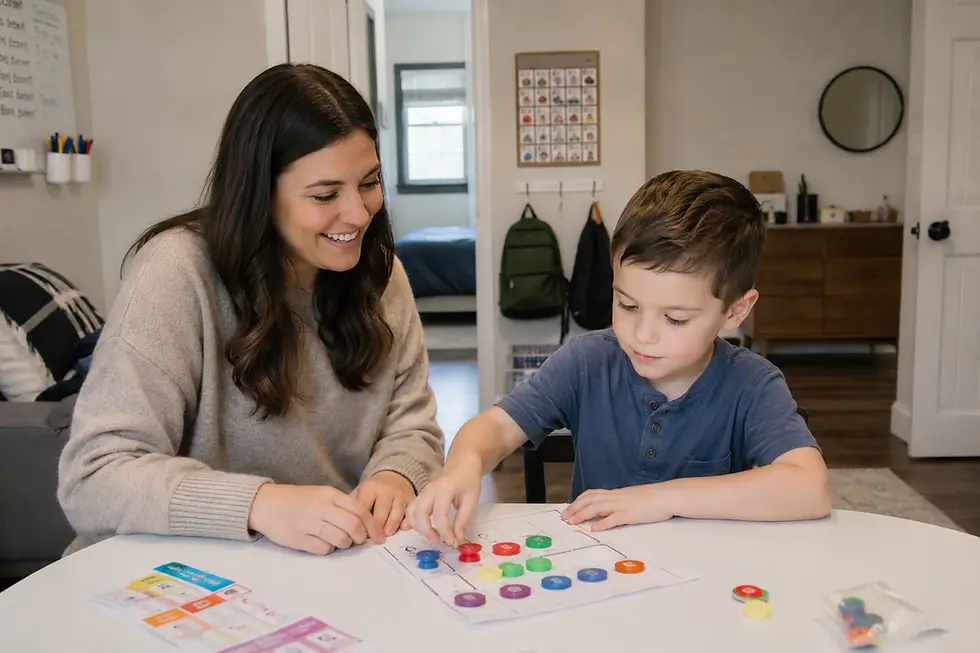
Here's the direct answer. A BCBA is a Board Certified Behavior Analyst who assesses your child, writes the treatment plan, supervises sessions, and trains you. An RBT is a Registered Behavior Technician who delivers the one-on-one therapy under that supervision. You'll see the RBT most often and the BCBA at regular intervals.
What is a BCBA responsible for?
The BCBA is the clinical lead on your child's case, even on days you never see them.
They run the initial assessment: the interview, the observation, the skills assessment, the functional behavior assessment. Seed & Grow explains its BCBA assessment and individualized treatment planning process, including functional behavior assessments and skill assessments such as the VB-MAPP, ABLLS-R, and AFLS. From that, the BCBA writes the treatment plan, the document with your child's specific goals, the recommended hours, and the data collection methods the RBT will use.
Once therapy starts, the BCBA supervises the RBT's work, reviews data on a regular basis, and adjusts goals when something isn't working the way it should. They train you directly too, not as an afterthought bolted onto the plan, but as a required part of it.
They're also the one who handles reassessment, roughly every six months, deciding whether hours should change based on actual progress. The number of weekly ABA hours depends on your child's individualized treatment plan and BCBA assessment.
What is an RBT responsible for?
The RBT is who your child spends the most time with. They deliver the direct, one-on-one sessions, running the specific teaching procedures the BCBA laid out in the treatment plan.
That means implementing the programs, working on requesting, following directions, reducing a specific behavior, collecting data during every session so the BCBA has something real to review, and following the plan as written rather than improvising on the fly.
Seed & Grow describes direct one-on-one ABA therapy as RBT-delivered treatment based on a BCBA-created plan, using structured and naturalistic teaching to build communication, social, daily living, and adaptive skills.
An RBT is not supposed to write goals, change the treatment plan, or make clinical decisions on their own. If a program isn't working, they report it up to the BCBA, who decides what changes.
A good RBT also communicates with you daily, in a small way. A quick note about how the session went, a win worth mentioning, a heads-up about something they noticed. That's part of the job, not a bonus.
RBTs work under different agencies with different staffing models. Some agencies keep the same RBT with your child for the life of the case, which builds consistency and rapport. Others rotate staff more, which can bring backup coverage when someone's out sick but can also mean more transitions for your child to adjust to. Ask about this directly when you're comparing providers.
How often should a BCBA be involved in my child's case?
More than most parents expect, even though the RBT is the face they see most.
The BACB, which certifies both roles, requires an RBT to receive supervision for at least 5% of the hours they spend delivering direct services each month, including at least two real-time contacts, one of which must include the supervisor actually observing a session. For an RBT working 80 hours a month with your child, that's a minimum of 4 supervision hours, not a courtesy check-in.
In practice, this looks like the BCBA periodically observing a session in person or over video, reviewing your child's data between visits, and meeting with you and the RBT to talk through progress and any needed changes. Seed & Grow also describes ongoing BCBA supervision and progress monitoring as part of its ABA care model.
If you've gone months without any contact from the BCBA directly, that's worth asking about.
What training does each one have?
An RBT completes a training based on a task list set by the BACB, passes a competency assessment administered by a qualified supervisor, and passes a certification exam. It's a meaningful credential, but it's an entry-level one, built to be completed relatively quickly so technicians can start delivering supervised therapy.
A BCBA holds a master's degree in behavior analysis or a related field, completes a set number of supervised fieldwork hours, and passes a much more rigorous certification exam covering assessment, treatment design, ethics, and supervision. It typically takes several years of graduate education and supervised practice to get there.
There's also a middle credential worth knowing: the BCaBA, a Board Certified Assistant Behavior Analyst. More training than an RBT, less than a BCBA, and always working under a BCBA's supervision rather than fully independently. Not every agency uses this role, but it's not unusual to see one on a larger clinical team.
Who do I call when something goes wrong?
This is the question a lot of parents never get a straight answer to, so here it is.
For anything about how a session went, a scheduling issue, or a concern about how the RBT handled a specific moment, start with the RBT directly if it's minor, or your BCBA if it's about the plan itself or feels bigger than a one-off.
For anything about the treatment plan, goals that don't seem right, hours that don't match what you were told, or a pattern of concerns with an RBT, go to the BCBA. That's their job, not something to work around.
If the BCBA isn't responsive, or the concern is about the BCBA's own conduct, the agency's clinical director or owner is next. Every legitimate ABA provider should have someone above the BCBA you can reach.
And if things genuinely aren't working after raising it through those channels, that's a real conversation to have, not something to just live with. Seed & Grow's guide on how ABA therapy helps children build skills that last explains why ongoing progress monitoring, family involvement, and adapting support to the child's needs matter throughout treatment.
Frequently asked questions
How many kids does one BCBA supervise?
It varies by agency and by how much direct versus supervisory work a BCBA does, and there's no single number required by the BACB. Ask your provider directly what your BCBA's caseload looks like. A BCBA stretched across too many cases has less time for the supervision your child is entitled to.
Can an RBT change my child's goals?
No. Goals come from the BCBA, based on assessment data and ongoing progress. An RBT delivers the plan and reports back, but changing a goal, adding a new one, or dropping one is a clinical decision that stays with the BCBA.
What is a BCaBA?
A Board Certified Assistant Behavior Analyst, a credential between RBT and BCBA. A BCaBA can conduct some assessments and supervise RBTs, but always under a BCBA's oversight. You might see one on a larger team, working alongside the BCBA rather than in place of one.
Want to know who's on your child's team?
If you're not sure who your BCBA is, or how often they're actually involved, that's a fair thing to ask before you sign anything.
Reach out to Seed & Grow ABA if you have questions about how the team is structured or what your child's ABA care will look like.



Comments